I've thought a lot about what I'd do differently if I started a SaaS from scratch in 2026. Not in the abstract. Concrete decisions. The plays I'd make on day 1, day 30, day 180. The mistakes I'd skip. The channels I'd double down on.
Most $0-to-$1M advice you read is either survivor bias or founder self-mythologizing. The version below is the one I keep coming back to when I look at the AI-native SaaS companies actually hitting that number in the last 18 months. Six sections. Roughly the order I'd run them in.
If I were starting today, this is exactly the playbook.
The right market beats the right founder (80% of the outcome)
The market you choose is the single most important decision in a SaaS. Everything else is downstream of it.
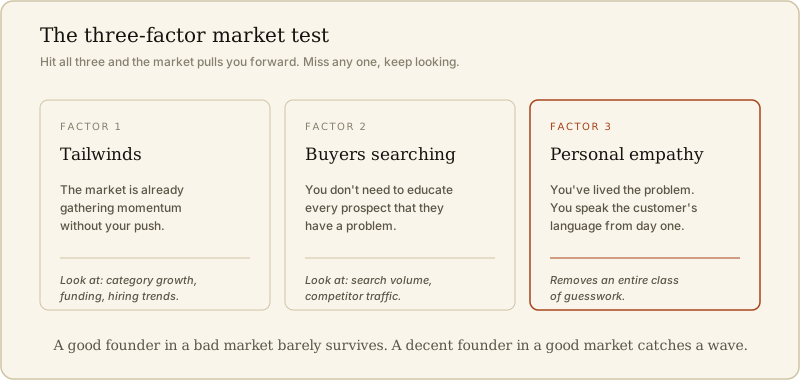
A good founder in a bad market grinds for five years and barely survives. A decent founder in a good market catches a wave they didn't have to generate themselves. The math on those two paths is orders of magnitude different, and the difference is set in stone the day you pick.
Three specific factors I look for in a market:
1. Tailwinds. The market should already be gathering momentum without your help. AI-native tooling, product-led growth motions, developer-facing infrastructure, industry verticals going through digital transformation. If the underlying momentum is against you, you'll spend your entire life pushing.
2. Buyers who already know they have the problem. There's a massive difference in CAC and sales cycle between a market where buyers are already searching for a solution and one where you have to educate every prospect from scratch. If you're doing the education work, you're funding the awareness that your competitors will free-ride on when they enter three years after you.
3. Personal empathy. You should have lived the problem yourself. This removes an entire class of guesswork. You don't have to check if the pain is real. You already know it is, and you already speak the language your customers use.
I spent five years earlier in my career building a B2B marketplace in a category buyers weren't actively searching in. It grew to $3M in revenue, and every dollar was hard-won because the market fought me at every turn. Buyers had to be convinced the problem existed before they'd consider a fix. When I started the next thing, the first thing I fixed was that.
If you can name the tailwind, the actively-searching buyer, and the specific pain you've felt yourself, you're in. If any of those three is missing, keep looking.
Validate before you write a line of code
Once you've picked the market, validate before you build. I mean specifically: get on calls with real potential buyers. Not just Twitter or Reddit posts asking "does this sound cool."
Twitter validation is worthless because "sounds cool" costs nothing. What you actually want out of a validation call is:
- Specific data about how they deal with the problem today
- The workarounds they've built (spreadsheets, hacks, third-party tools)
- The real cost they're paying in time, money, or effort to work around the gap
- A letter of intent, ideally with a specific price they'd pay when you launch
There's a chasm between someone saying "great idea" and someone signing an LOI. The only way to know which side of the chasm you're on is to have the conversation and ask for the commitment.
For the SaaS I'd build today, that means at least 100 conversations before I write meaningful code. Ten a week for ten weeks. Every conversation clears fog on a small part of the customer's problem space. By the end of the hundred, you have expert-level intuition on where value actually lives: the specific workflow, the specific handoff, the specific frustration a product could actually solve.
That intuition is your compounding asset from that point forward. It shapes every product decision, every messaging call, every prioritization argument for the next three years.
Build product-led from day one, not sales-led
This is the one I'd change most from my past behavior. My first SaaS was sales-led. Every customer had to be personally pitched, and the entire company's growth was gated by how many demos I could give in a week. That model has a hard ceiling, and if you don't build for scale from the start, you'll hit it 18 months in and never get past it.
Build product-led instead. Meaning: someone finds your product, tries it, gets value from it, and pays for it without ever talking to a human on your side.
This forces every part of your product to earn its keep. The onboarding has to actually onboard. The messaging has to actually convert. The upgrade flow has to actually upgrade. In a sales-led company, a good AE compensates for a confusing product. In a product-led company, a confusing product just doesn't get bought.
Practically, that means:
- Free tier with real value, not a demo-quality trap
- Zero-friction signup (email or Google, no credit card)
- Onboarding that reveals the "aha" moment in the first three minutes
- In-product upgrade paths at the moments users hit the paywall
The reason this matters more in 2026 than it did in 2018 is that buyers are more allergic to sales calls than they've ever been. Every B2B software category has 30 competitors now. The one that lets you try it in your browser at 11pm on a Tuesday is the one that gets the credit card the next morning.
Do things that don't scale (Reddit and done-for-you demos)
Your first 100 customers won't come from a repeatable channel. They'll come from you personally showing up in places your future customers already are, and adding value one at a time.
Two specific unscalable plays I'd run:
Reddit and community answers. Find the subreddits, Discord servers, and forums where your ideal customers hang out. Answer questions there using your own product as the mechanism to help. If someone asks about a workflow challenge and you build them a fully-functional version of the solution with your product, then hand it over for free, you've done two things at once: added real value, and shown a specific person exactly what your product does. Some percentage of the thread will sign up. More importantly, the thread stays searchable for years.
Done-for-you outreach to relevant launches. When a company you'd love as a customer ships a new feature, proactively build a small thing for them using your product. Email their founder: "Congrats on the launch. I made this quick asset for your announcement, feel free to use it or plug it into your product-update blog." That's a warm-outbound message that costs the recipient nothing to accept and delivers real value. Response rates on that pattern are 5-10x cold outbound.
Founder-led outreach beats delegated outreach almost every time in the first 12 months. You can hire a BDR later. Right now, you're the only person in the company who understands the customer well enough to write a message they'll respond to.
Layer in channels that run without you: product-led SEO, comparison pages, referrals
Around $100k-$500k ARR, the founder-led work stops being enough. That's when you layer in channels that keep working while you sleep. My rule: test one new channel every month, run it long enough to get a real signal, then decide to stop, continue, or scale.
Three channels I'd prioritize above all others:
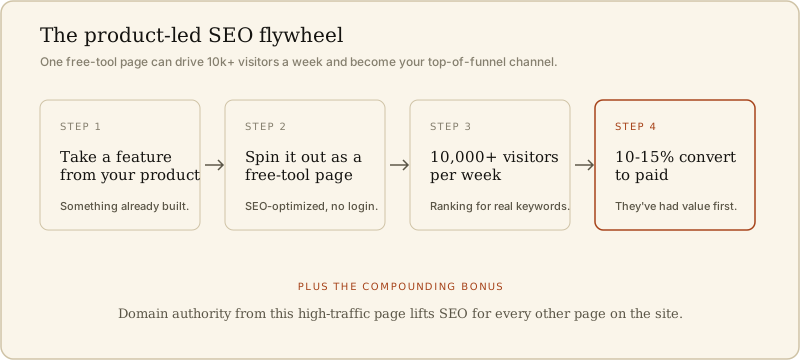
1. Product-led SEO. Take a feature that already exists inside your product. Spin it out as a standalone free tool on an SEO-optimized landing page, no login required. You're giving away real functionality for free on a page ranking for a specific keyword your future customers search.
The math: 90% of people using the free tool never convert, and that's fine. The remaining 10-15% who do have already experienced real value before they saw a pricing page. They convert at a much higher rate than any other cold traffic source. And the domain authority from a high-traffic page lifts the entire site's SEO for your bottom-of-funnel pages too.
One free-tool page done right can drive 10,000+ visitors a week and become the top-of-funnel channel for the whole company. That's the ceiling I'd aim for.
2. Comparison pages. For every competitor in your category, build a page targeting "[competitor] alternatives" and long-tail keywords like "[competitor] vs [category]". These convert at 20%+ visitor-to-signup for the accounts I've watched run them, because the traffic is late-funnel by definition. Someone searching "X alternatives" is already primed to switch.
3. Referral and viral levers. Small in-product mechanics that make existing users bring in new ones. A "made with [your tool]" watermark on shared outputs. Team invites that reveal more features. A branded footer on emails sent through your product. Each of these compounds slowly and starts to matter around 10,000 active users.
The order matters. Product-led SEO first (highest ceiling), comparison pages second (highest conversion), referral levers third (highest compounding). Don't try to run all three at once.
Price up early and treat retention as a growth lever
Two things founders under-invest in that I'd fix from day one.
Charge more than you're comfortable with. Every early-stage founder underprices because they're scared raising prices will kill growth. In my experience the opposite is true. Every time I've 3x'd or 5x'd pricing on a SaaS, churn went down. Higher prices force you to deliver higher value, and they filter out the customers who churn quickly anyway. Serious buyers expect serious prices. Cheap products signal cheap value.
If defending your price feels comfortable, you're probably underpriced. If it feels a little uncomfortable, you're probably close to right. If customers tell you they'd pay double and you keep the current price, you're leaving money on the table and attracting the wrong buyer profile.
Treat retention as a growth lever, not a cost center. The revenue chart from $0 to $1M is full of plateaus. Most of those plateaus aren't caused by slow acquisition. They're caused by churn eating what you acquired. If your monthly churn is 8%, you're replacing 96% of your revenue every year before you grow. If your monthly churn is 3%, you're compounding.
The single biggest lever on churn is customer support quality. Small teams with world-class support beat big teams with slow support every day. The founder personally responding to every ticket in the first year is a competitive weapon. Big incumbents structurally cannot match your speed or personal attention.
If I were starting today, I'd budget 20% of my week for direct customer conversations from day 1 through the $1M mark, all done by the founder, not through a CS hire.
That's the whole thing. Pick a market with tailwinds and actively-searching buyers. Validate with real conversations and LOIs. Build product-led from the start. Do things that don't scale to get your first 100 customers. Layer in product-led SEO, comparison pages, and referrals to get to $1M. Price up early. Treat retention as growth.
If you're building today and you want to see the underlying stack that makes this playbook runnable by a small team, the current AI stack lives here. What one operator plus a few agents can actually produce per week sits in the breakdown a little further down. More long-form breakdowns of specific plays in this shape live in Writing.
The compounding is what makes this work. Six months of discipline on all six of these gets you to $500k ARR. Twelve months gets you past $1M. Anything less than the full six, and you'll plateau somewhere between $50k and $250k and blame the market.