Every AI company I've talked to in the last 12 months has a strategy deck with a slide labeled "our moat is X." Nine times out of ten, X is one of three things: "we have the best model," "we shipped first," or "we're six months ahead." Each of those is a lead, and leads run out.
The uncomfortable part is that this isn't a new insight. Snap figured it out 15 years ago after watching every feature they invented get cloned by a company with more distribution. Stories, AR lenses, face filters, swipe-based navigation. All lifted. Snap ended up investing heavily in things that resist copying: hardware, ecosystems, and creator relationships.
Every AI company is about to run through the same lesson. Faster, because the barrier to clone a software feature is now weeks instead of quarters. Here's how I think about it, with my own take on what actually holds as a moat when the software itself doesn't.
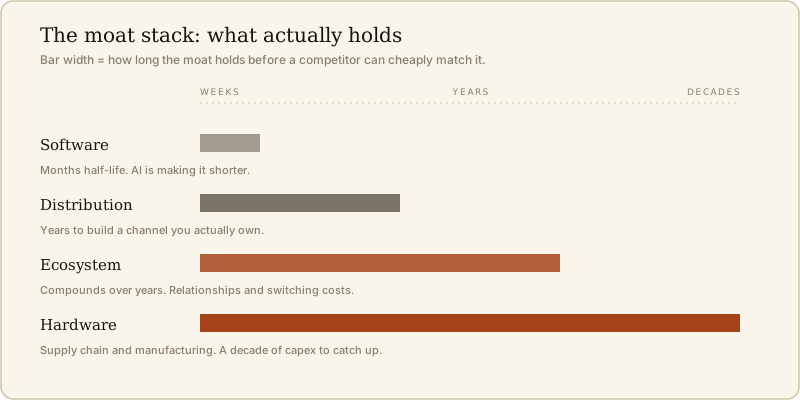
Software has never been a moat. AI is making that painfully obvious.
Watch what happened to Snap's roadmap over the last decade. They invented ephemeral messaging. Facebook cloned it. They invented stories. Instagram cloned it, and it now runs on every social platform. They popularized consumer AR lenses. Meta and TikTok both have functional equivalents. They shipped swipe-based navigation before it was standard. Now it's standard.
Each of those inventions took Snap 6 to 24 months of design and engineering. Each clone took the copier 3 to 6 months. The math is brutal: the inventor pays the R&D cost, the copier pays the reproduction cost, and the copier usually wins because they have more users to distribute to.
Software gets copied because software is code, and code is legible. If I can see it running, I can figure out how to build my own version. In 2026, the reproduction cost dropped further because the copier doesn't need a full engineering team. They need a well-briefed AI agent and a two-week sprint.
The AI equivalent is already playing out. Every wrapper company that reached traction in 2024 discovered that OpenAI, Anthropic, or Google eventually ships the thing they were charging for. The half-life of a "we have the best RAG pipeline" claim is about three months now. Maybe six on a good day.
If your entire moat is software you wrote, it's a lead with an expiration date.
What "distribution as the real moat" actually means
If the software itself doesn't hold, what does? Distribution. Meaning: your ability to reliably reach the users you want, at scale, without paying arbitrage prices to a platform you don't control.
Two companies I keep coming back to when I think about this. TikTok didn't have distribution when they started, so they bought it. They spent billions of dollars subsidizing both sides of their video marketplace: acquiring viewers, and paying creators to make videos. Most people at the time called it reckless spend. TikTok was buying distribution. Everyone else thought they were buying content.
Threads did something different. They didn't need to build distribution, because they launched on top of Instagram's. On day one, everyone who followed you on Instagram was suggested to you on Threads. Threads inherited distribution instead of building it, and that's what got them to 100 million users in five days.
The lesson for AI companies: solve distribution from day one, in parallel with product-market fit. In practice, that means:
- Own a channel with recurring reach. Newsletter, community, podcast, YouTube.
- Build integrations where your users already work. Slack, Notion, VS Code, CRM.
- Pick a beachhead you can dominate before you go horizontal.
Every AI company that treated go-to-market as a "we'll solve it after revenue" problem is now paying platform tolls to compensate.
Ecosystems compound. Features get copied.
The other durable thing Snap built is an ecosystem. There are millions of AR lens developers on their platform. Thousands of creators run their business through Snap. Advertisers have workflows built around Snap Ads.
None of that shows up as a feature. All of it is nearly impossible to copy, because copying requires re-onboarding every one of those relationships, and relationships have switching costs.
For AI companies, the equivalent is:
- The developers who built on top of your API and now have production workloads running there.
- The customers who integrated your product into their internal workflow so deeply that ripping it out means retraining ten teams.
- The data flywheel that makes your product measurably better than a fresh competitor's, even if their model is technically newer.
Ecosystems don't move fast. They compound. Take OpenAI. GPT-5 will be matched by Claude or Gemini within months of release. What compounds and gets harder to catch up on is the tens of thousands of production integrations built on their API, the enterprise agreements with switching costs, and the ChatGPT consumer habit graph.
If you're building an AI company and you can't name three ecosystem plays you're compounding on, you're one competitor release away from margin compression.
Hardware and the physical layer as the ultimate lock-in
Snap has been investing in hardware for over a decade. Drones, Spectacles, and now the new Specs with a full AR operating system. From the outside this looks like a hobby. It isn't. Hardware is the one layer that pure software companies can't replicate on a whim.
You can't AI-agent your way to a working AR display in six months. You need supply chain relationships, manufacturing capacity, and years of vertical integration. The cost of entry is measured in hundreds of millions of dollars and multiple product cycles.
For AI, the parallel is already visible. Anthropic and OpenAI are both moving toward tighter chip relationships. Rabbit and Humane made hardware bets that didn't land, but the underlying instinct was correct: build the physical device your users touch, and you own the interaction layer. When someone else's product wants to reach the same user, they have to go through the piece of glass in your customer's hand.
Not every AI company should chase hardware. The ones that should are the ones where the interaction layer itself is the product. If your differentiation is voice, physical presence, or ambient computing, hardware is your best defensive investment.
What this means for AI companies right now
Most Series A and B AI decks I've seen this year still lead with model quality or feature velocity. Both are legitimate short-term advantages. Neither survives a full competitive cycle.
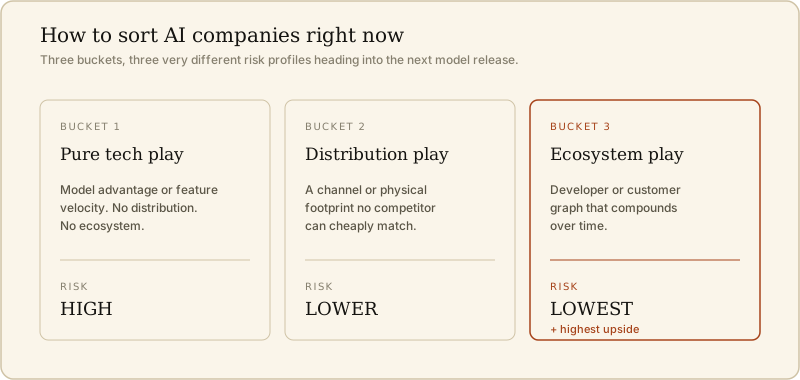
Here's the sharper version of the map. Sort AI companies into three buckets:
- Pure tech plays with a model advantage and no distribution or ecosystem strategy. High risk. The moment a foundation model catches up, the business compresses.
- Distribution plays that have a channel or a physical footprint no competitor can cheaply match. Lower model risk. GPT-5 shipping is a headline, not an existential threat.
- Ecosystem plays with a developer or customer graph that compounds. Middle risk, but the highest upside because ecosystems only get harder to displace over time.
The winners of the current wave are going to be in buckets 2 and 3, and the merger of the two. The companies most at risk are the pure-tech plays without an obvious answer to "what happens when GPT-6 does this natively?"
If you're a founder, the punch-list I'd actually run:
- Name your distribution moat in one sentence. If you can't, that's the priority.
- Identify one ecosystem you can compound on for the next 3 years. Invest disproportionately in it.
- Retire the "we have the best model" story from every deck. It's true right now. It won't be next year.
The one place I'm putting this into my own work
The reason I care about this isn't academic. I run an AI-native marketing practice, and I think the same logic applies at the level of an individual operator.
My software stack is replicable. Anyone can buy the same tools I use, and if you want the shopping list, the stack I run today is on the home page. What comes out the other side of that stack is on the breakdown a little further down. Both of those layers are copyable if someone watches me long enough.
The one thing that isn't copyable is the audience I build around all of it. The compounding trust that comes from showing up in Writing every week with something useful, and the readers who now check in without a nudge, is the piece nobody can shortcut.
That's my own version of the same lesson. Software is now table stakes, and distribution is what compounds. The only way to build distribution is to keep showing up in a channel you control, for long enough that no one else can cheaply catch up.
If you're building an AI company right now, that's the frame I'd use. Everything else is a lead. Leads run out.