Every SaaS I've worked with in the last 18 months has quietly rebuilt its marketing motion, and almost nobody's talking about it publicly. The old playbook, where you buy a list, run a sequence, and hope for a 1% reply rate, stopped converting. Not slowly. All at once.
I've been in the room at more than one company as this shift happened. The pattern is consistent. Seven things are working in SaaS marketing right now, and every one of them is a variation on the same underlying rule: people trust people, not logos.
Here's what I'm actually seeing.
Why old-school outbound stopped working
Six months ago it took roughly 150 cold emails to book a meeting for one of the accounts I was watching. Today it takes roughly 600. Same list quality, same sequencer, same reps. The volume to hit the same number quadrupled.
Nothing about the target changed. What changed is that every other SaaS is now doing exactly the same thing with the same AI copywriting tools. Buyers' inboxes look like eight variations of the same email. When every message reads identical, none of them convert.
The tell is that everyone's response rate flattened at the same time. The problem is channel saturation, not copy quality. And no amount of copy iteration fixes a saturated channel.
That's the first thing to accept before anything else in this piece makes sense. Cold outreach still works, but it works differently, and it works in combination with other things that weren't necessary in 2020.
Let me walk through what actually is working. One outbound motion, then six inbound plays that build the trust the outbound can't. All seven are part of the same picture, which I'll pull together at the end.
The outbound rule in 2026: intent signals drive timing
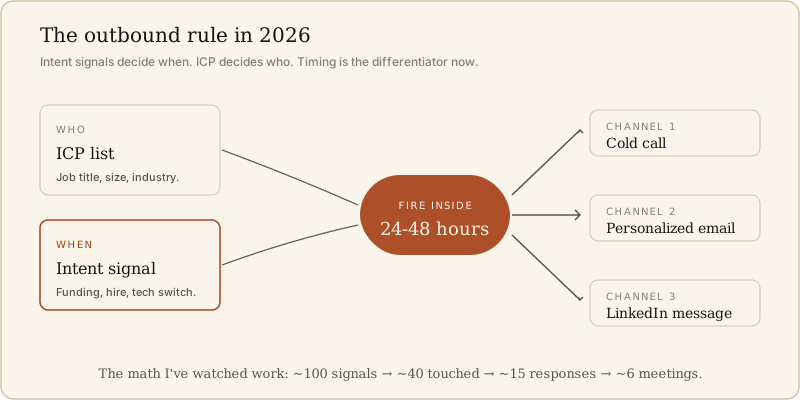
The version of outbound that still works layers intent signals on top of the ICP list. The ICP tells you who to reach out to. The intent signal tells you when. And in 2026, when matters way more than who.
Intent signals I actually watch for:
- A company just had a leadership change (new decision-maker looking for wins)
- A company just closed a funding round (budget just showed up)
- A company is hiring for a role in your product's category (they're admitting the gap)
- A company just added a tool your product plays nicely with (they're actively building a stack)
- Someone at the company visited your site more than once in a week
- Someone at the company engaged with your content
When the signal fires, you have a 24-48 hour window to hit them with a coordinated three-channel touch: a cold call, a personalized email, and a LinkedIn message. The three channels compound. Each hit reinforces the other two, and the prospect who ignores one channel remembers three.
The math I've watched work at multiple accounts: 100 signals fired → around 40 touched inside 24 hours → around 15 responses → around 6 meetings booked. That's a 6% signal-to-meeting rate, roughly 6x what a cold-list-only motion produces at the same volume.
Companies still running list-only outbound in 2026 are going to spend the next 18 months confused about why their reps' numbers dropped and their competitors' didn't. The reason is buried in the timing.
The operational trap most SaaS teams fall into: they buy intent-data tools but never wire them into the sequencer or the SDR workflow. The signal fires, an alert lands in someone's inbox, nobody sees it for three days, and by then the window closed. The tooling is worthless without the operational hookup.
Fix that first. The rest of this post assumes your outbound is already timed to intent, not just aimed at a list.
Three "real people" plays: EGC, influencer, UGC
Everything after outbound is about building trust before the first conversation. Three plays do this by putting a real person in front of a buyer, and each works because the buyer's brain reads them as "a person telling me something" instead of "a company selling me something."
Employee-generated content. Real employees posting on LinkedIn about the product they work on, the customers they help, what they're learning day to day. Gong's employees are the case study I'd point at. Personal stories that happen to touch on the company's category. Casual, self-authored, minimal production.
The reason this works isn't complicated. When someone reads "Company X is the best" in a company post, they discount it. When someone reads an employee saying "I spent this week helping a customer figure out Y, here's what I learned," they don't discount it, because the employee has no incentive to lie to their own network. The signal reads as genuine because the incentive structure is genuine.
Influencer marketing. The version that works in B2B SaaS isn't celebrity-endorsement. It's a native voice already in the category, usually 10-30k followers on LinkedIn, talking about your space every day with real credibility with the exact buyers you want. Their content isn't scripted or brand-approved. It's their own words, their own tone, their own take on your tool.
Companies actually running this today: ClearScope, Apollo, Tavus. If you're on LinkedIn in any B2B category, you can see the shape of this once you know to look for it.
The economics are also better than paid ads. A $2k-$5k monthly retainer with a native-voice influencer can outperform $20k of Meta Ads to the same audience because the trust discount doesn't exist.
User-generated content. Real customers making short videos about your product because they actually use it, or paid UGC creators making content intentionally designed to look and feel unpolished. TikTok and Instagram Reels are where this lives most, but it works on LinkedIn too.
The finished asset should feel like a testimony. If it looks like it came out of a video production shop, it lost. The whole point is that the buyer's brain reads it as "a person told a friend about this thing they liked" rather than "a company paid for this."
Lovable is running the best UGC campaign I've seen in the last quarter. Every one of their creator videos feels like someone showing their friend a cool tool.
The pattern across all three plays: real person, minimal production polish, incentive structure that reads as trustworthy.
Distribution multipliers: long-form YouTube + clipping
The three "real people" plays produce trust one asset at a time. That's expensive per touch. The multipliers turn each asset into 10 or 50 pieces of distribution.
Long-form YouTube. A 10-15 minute YouTube video builds a level of authority a 30-second clip can't replicate. Someone who spends 12 minutes with you develops a different relationship with your brand than someone who saw a reel. That relationship is what converts eight months later when they finally search for your category on Google.
The catch is that long-form takes 6-12 months to see traction. Most SaaS companies aren't patient enough. The ones that are (instantly.ai is the current case study) end up owning the top of the search-and-recommendation funnel in their category.
Clipping. This is the play most companies haven't even heard of yet. There are two pieces to it:
- Cutting long-form video into short-form clips and posting them on TikTok, Instagram Reels, LinkedIn video, and YouTube Shorts. One 12-minute video produces 15-30 clips.
- Running sub-accounts (secondary handles) that repost your top-performing clips. This looks like it should feel inauthentic, but the platforms don't punish it if the content is genuinely good, and it multiplies your reach 3-5x.
Alex Hormozi's team is the clearest example run at scale. He shoots long-form on his main channel, and dozens of clipping accounts across every platform push the clips into every algorithm. Most people who "know Hormozi" have never watched a full video of his. They've seen 40 clips.
The reason clipping works: producing brand new content every day is unsustainable for one person. Nobody has that bandwidth. Clipping takes content that's already proven to resonate and multiplies it across formats and accounts. It's the most efficient distribution mechanism I've watched a SaaS team run.
The two plays only work together. Long-form gives you source material to clip. Clipping gives your long-form the audience it needs to compound.
The meta-strategy: a real face on the brand
Here's the thing that ties every play in this post together.
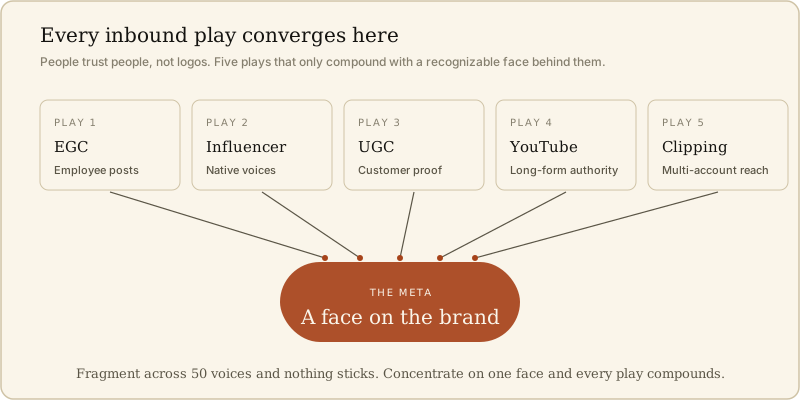
Employee content works because it's a real person talking. Influencer marketing works because it's a real person talking. UGC works because it feels like a real person telling the truth. Long-form YouTube only compounds if there's a consistent face people come back for. Clipping multiplies content, but the content only converts if the face behind it is someone people recognize.
Every play is a variation on the same underlying rule: people trust people, not logos.
The strategic move that follows: put a real, consistent face on your brand across every channel. One face. The same face on LinkedIn, on YouTube, in the podcast, in the ads, in the newsletter.
The Jake from State Farm / Flo from Progressive model, but for SaaS.
Founder-led is the easier version. Every founder-led SaaS I've watched grow past $10M ARR uses the founder as the face of the brand. The current wave of "AI CEO on Twitter" is playing this game explicitly, and their content converts because the buyers know the person.
Non-founder-led is the harder version, but it works. What most SaaS companies do is hire a marketing person, ask them to post on the company account, and wonder why nothing converts. What the ones getting it right do is hire a marketing person, tell them to post on their own personal account under their own name, and let them become the face people trust.
Both routes end in the same place. A person, not a logo, is the trust asset. Everything else in the marketing stack is designed to distribute that trust asset to the right buyer at the right moment.
If you're a SaaS marketer reading this and your company still runs the "company page posts once a day" playbook, you're 12-18 months behind. The gap widens every quarter until someone at your company either becomes the face or hires someone to be it.
What I run for my own portfolio
Everything above is what I watch play out inside the SaaS teams I work with. It's also what I run on my own portfolio.
The stack looks like:
- Long-form: this site, plus the essays I publish here every 1-2 weeks
- Real-person distribution: LinkedIn, X, and one podcast, all under my own name
- Multipliers: each essay becomes 5-8 short-form posts across LinkedIn and X
- Underlying tools: the current AI stack lives here, and more long-form posts in this shape live in Writing.
The setup works because everything points at one recognizable person, so every touchpoint compounds trust instead of splitting it across 12 anonymous accounts.
That's the whole play in 2026. Every marketing motion I've watched succeed in the last 18 months follows the same pattern. If you're building a SaaS or advising one, the single highest-impact thing you can do this quarter is decide who the face of the brand is going to be and start putting them everywhere, consistently, for the next 12 months.
The compounding starts at month 4. The competitive advantage shows up at month 12. Anything shorter than that and you'll conclude the play doesn't work and go back to logo-driven content that nobody trusts.