Most B2B SaaS teams I've talked to in the last 18 months are still buying more cold email tools, and it's making them poorer at reasonable CAC. The push motion is a losing game. Pull is how you actually get to recurring inbound.
I've watched this play out enough times now that I want to write down the map I run in my head when a founder asks me how to think about their GTM in 2026. There's a whole spectrum, from cold email at one end up through paid ads at the other, and every move belongs in a specific place on it. The pull side has a specific shape, not a vibe.
Here's the walk-through, plus the three steps I use when I actually implement it, plus where AI-native marketing changes the math.
Push vs pull, in one map
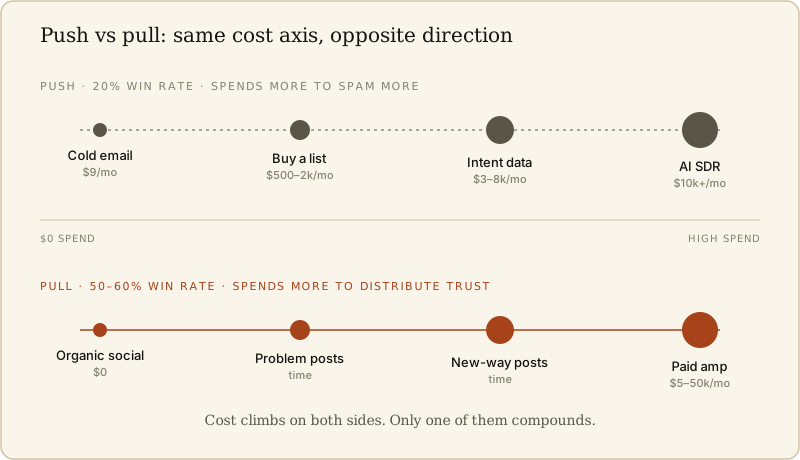
The map is a horizontal spectrum. The left end is $0 in spend. The right end is "as much money as you want to burn." I walk up that spectrum twice, once with push moves and once with pull moves, and each side gets its own shape.
Push starts almost free (cold DMs from a $9/month tool) and gets expensive fast as you buy lists, plug in intent data, and pay for AI SDRs. Pull also starts almost free (organic posts on the platforms your ICP already sits on) and gets expensive fast as you graduate into paid amplification of the same content. Both cost money at the top. What differs is what the money buys.
Push spends more to spam more. Pull spends more to distribute earned trust. Same axis, opposite direction.
The push strategy: expensive theater with a 20% win rate
Push looks cheap on day one. You buy a $9/month tool, blast 100 cold emails, get a couple of replies. The math for "keep going" then looks tempting because the marginal cost per email is so small.
Here's what "keep going" actually looks like when I've watched teams do it:
- Buy a list. Now you're spamming 15,000 people to catch a 1% response rate.
- Plug in intent data. This is stalking with a nicer name. You monitor social feeds for people mentioning your problem, then email them saying "I saw you liked our competitor's post."
- Hire (or subscribe to) an AI SDR. The spam machine, plus plus.
- Get on the sales calls. Most of the people you got on the call don't actually want to be there, so you spend the call justifying why you're better than the competitor whose post they liked.
Win rate at the bottom of that funnel: about 20%. And every month you have to buy more lists to keep the 1% response rate flowing.
Why push costs more than it looks
This is the part I think most founders underprice. Everyone treats outbound as "cheap" because they're anchored on the $9 tool.
The actual bill: list purchases, email deliverability infra to keep you out of spam, intent data subscriptions, plus the human time your account executive burns on 20-percent-win-rate discovery calls. Add all of that up and "cheap push" is anything but. It also doesn't compound. Next month, the list is stale and you buy a new one.
Cold email in 2015 had a real signal advantage. Fewer emails in the inbox, higher response rates, no AI-generated first touches for the reader to sniff. In 2026, everyone's inbox is 60% AI-authored spam and the recipient can smell it. Response rates keep dropping and cost keeps rising, so the ROI curve inverts. The move that used to be a good idea is now a bad one.
The pull strategy: create demand, then meet it
Pull flips the direction of the interaction. The prospect walks into the sales call already leaning in, because they came to you.
Where a lot of pull advice stops at "post content and hope," my version has a specific four-move structure. And the moves only work in this order:
- Post organic on the platforms your ICP already sits on (LinkedIn, X, wherever).
- Post about problems. Not selfies. Not "5 lessons from my morning routine." Actual urgent problems your ICP feels every week.
- Introduce a new way to solve those problems. "This is what people used to do. Here's the new way. Here's why the new way exists now." Your product happens to embody the new way, but you're pitching the shift, not the product.
- Turn your best-performing posts into paid ads once the inbound flow starts. You're now paying to distribute content that already earned trust organically, rather than paying to interrupt people who never asked.
The order matters. Ads before organic proof of message-market fit is just push wearing a nicer outfit.
What pull actually looks like end-to-end
Here's the piece that's easy to miss. Pull still uses outbound. What changes is that the target is already warm when the AE opens the conversation.
An example. Someone in an enterprise org downloads your guide. You now have one hand-raiser. What you do next is map the organization. Who's the CRO, the CFO, the CEO, the head of marketing, the buying committee. You send targeted outbound to those specific people, using your best-performing content as the message. Same channel as cold email. Totally different signal-to-noise.
At the top of the pull spectrum, you're still spending money. You're just spending it to amplify content that a real audience already validated, and to open conversations with orgs where at least one person raised their hand. Those two properties are why the economics change.
The win rate math: 50%+ vs 20%
The teams I've watched run both motions see the split cleanly. Push: 20% win rate, longer sales cycle, more calls per close. Pull: 50 to 60% win rate, 1 to 2 call closes.
The reason isn't magic. When a prospect books a meeting on their own after two months of consuming your content, four things are true before the AE says hello:
- They know they have the problem you solve. (You educated them.)
- They believe the "new way" framing. (You anchored it.)
- They trust you more than the alternatives. (You built the equity.)
- They see you as the alternative to the status quo, with the three competing tools out of the frame.
That's a sales call that closes in one or two touches. The push equivalent is a call where the AE spends 40 minutes explaining who you are.
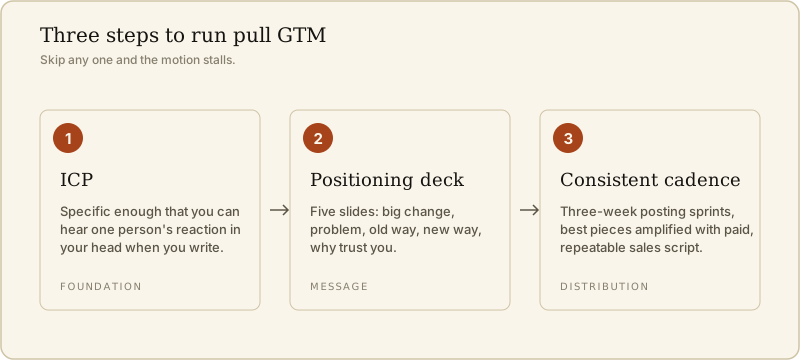
Three steps to run it: ICP, positioning deck, consistent cadence
I've watched enough founders skip one of these three steps and then wonder why "the pull thing didn't work" that I want to spell them out cleanly.
Step 1: Ideal Customer Profile. More detail is better. Job title alone isn't enough. You want the ICP specific enough that when you write a post, you can hear one specific person's reaction to it in your head. Vague ICP produces vague content produces zero inbound.
Step 2: A short positioning deck. Five or six slides that lay out:
- The big change happening in the market (urgency).
- The problem that change creates.
- The old way of solving it and why it's failing now.
- The new way (which is your product's shape, without pitching the product).
- Why you're the ones to trust on it.
The deck is your source of truth for every post, every ad, every sales deck. If you can't say it in five slides, your positioning isn't clear enough to run pull GTM on.
Step 3: Consistent cadence. This runs in sprints. Three weeks of daily posting, then take the best pieces and put paid distribution behind them, then run the sales process on the resulting inbound with a repeatable script. No posting once and giving up.
The consistency is doing real work here. It's the difference between "we tried content and it didn't work" (posted for two weeks, quit) and "content is our biggest channel" (ran for a year with a clear format).
The compounding flywheel and category creation
The reason pull compounds and push doesn't is that pull produces artifacts. Every good post is reusable as an ad. Every closed customer is reusable as a case study. Every recorded sales objection is reusable as next week's post.
Push produces used lists. That's it.
Run pull for a year with clear positioning and you don't just have a lead engine, you have a category. People start describing their problem in your language before they book the call, which is what "category creation" actually looks like at the working level. There's a halo effect around the company, and you stop having to argue for the framing because the market already accepted it.
Where this fits in an AI-native marketing stack
The pull motion is the exact motion an AI-native marketer can now run with a small fraction of the headcount it needed five years ago. The three steps (ICP, positioning deck, consistent cadence) all become tractable for a single operator plus a few agents:
- ICP is a research artifact. Claude plus a well-briefed research agent can build a very sharp one from public signal: transcripts of customer calls, review-site data, LinkedIn activity of your best-fit accounts. What used to be a two-month exercise for a demand-gen lead is now a two-day one.
- Positioning deck is a taste artifact. Once you have the ICP, drafting five slides is one long working session, not a quarter of committee edits. This is the piece where a real human still has to make the calls: positioning is where judgment sits.
- Consistent cadence is where AI pays for itself. Daily posting used to require a content team. Now it requires a repeatable pipeline that turns one hour of your thinking into a week of distributable posts. Paid ads sit above that pipeline as the final layer.
That's roughly the loop I try to run on my own work. If you want the wider view of the tools underneath it, the current stack lives here. What one operator plus a few agents can actually put out is spelled out on the home page section a little further down, and more long-form breakdowns of AI-native marketing motions are in Writing.
The one thing I'd underline: pull GTM gets better the more AI you have working alongside you, not worse. Push gets worse (because everyone else's push is also AI-powered now, so the signal drops to zero). If you were on the fence about which motion to invest in for the next 12 months, that asymmetry alone should decide it for you.