Meta Ads in 2026 has one lever left. Media buying used to be a lever. Audience selection used to be a lever. Campaign structure used to be a lever. Meta has spent four years automating all three of those to the point that broad targeting plus Andromeda plus a simple ASC structure is objectively the right default 99% of the time.
What's left, and what actually still moves the P&L, is creative. The ads. The hooks. The scripts. The personas you're speaking to, the angles you take, the formats you produce, and the volume of all of that flowing through the account.
Every dollar of Meta Ads margin I've watched a brand capture in the last 18 months has come from getting sharper on creative production. Every dollar I've watched brands lose has come from treating creative as a cost center they can minimize.
Here's my full playbook for how I run Meta Ads creative in 2026. It's long because this is the one thing worth going deep on. If you're a founder or a marketer running Meta at any real spend level, this is the whole map.
Why creative is the only lever left in 2026
I've been running Meta Ads accounts since 2018. Between 2018 and 2021, media buying itself was a real edge. The people who spent 12 hours a day inside ads manager and knew every bidding trick could out-perform someone who just showed up and picked reasonable defaults. The skill gap was wide, and every skill gap creates an arbitrage.
Meta has spent the last four years closing that gap. Targeting is now essentially fully automated. Interest targeting, which used to be a meaningful edge, is broken in most accounts (99% of accounts should just run broad). Bidding hacks that used to give you 15-20% cost improvements don't work. Duplicating ad sets doesn't work. Consolidation is now the objectively correct structure for every account under about $500k a month in spend.
The arbitrage didn't disappear. It moved. And it moved into creative.
The reason it moved into creative is that most people are terrible at creative. Not in a small way. Most brands I audit produce three types of ads (a lifestyle photo, a talking-head UGC, a product-on-white), can't articulate their persona beyond "moms in their 30s," and their hook is some version of "check out our product." That leaves an enormous gap for anyone who can produce genuinely well-thought-through creative at volume.
So the play in 2026 is simple in principle: get very good at creative strategy and production, and run that output through a well-structured account that lets Meta's algorithm do what it's now genuinely good at. If you get this right, you'll compound at 30-50% margin every quarter. If you get it wrong, you'll watch your CAC creep up 5-10% a month with no obvious cause and blame the algorithm.
The rest of this guide is how to get it right.
The portfolio model: why 3 great ads will kill your business
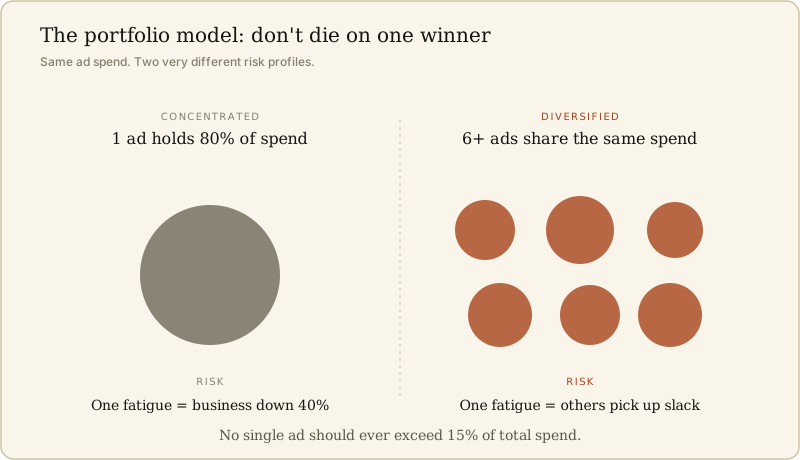
Here's the setup I've watched destroy the most eight-figure brands in the last two years. They find one, two, or three winning ads. Those ads hold huge amounts of ad spend at good ROAS. The founder concludes that creative production is expensive and unnecessary, so they slow it down. Six months later, the winners fatigue. There's nothing in the pipeline. Revenue goes down 40% year on year. They call me.
I always turn those accounts down now, because the fix window closed six to eight months earlier, and you can't rebuild a creative flywheel from a standing start when your revenue is collapsing.
The portfolio model prevents this. You want as many ads as possible holding as much spend as possible, with no single ad carrying more than 10-15% of your total spend at any point. If any single creative fatigues, the others pick up the slack. If two fatigue, you still have runway. If three fatigue simultaneously, you're only in real trouble because you started planning six months late.
The math on this is worth internalizing. Every single ad you launch has a fatigue ceiling, which is the maximum ad spend it can hold before returns collapse. For most ads, that ceiling is somewhere between $700 and $1,500 lifetime spend. Some winners can hold $50,000 or $100,000. But the mean is low, and it means you need to be launching a lot of ads for the account to hold the spend you want it to.
Three practical rules I run:
- No single ad should ever exceed 15% of total spend. If it does, you have concentration risk. Build variants and diversify.
- You should have at least 6-8 concepts active in the account at any time. A concept is a distinct persona-angle-offer combination, which I'll define in a moment.
- You should be launching new creatives every single week. The moment production slows down, you're on borrowed time.
If you're running Meta ads at any serious scale and you can't quickly answer "how much spend is my top ad holding right now," that's the first thing to fix. Concentration risk is the number one killer of accounts, and it hides in plain sight because the top ad looks like it's working great until the day it doesn't.
How Andromeda actually works, and what that means for you
Meta shipped a major algorithm change called Andromeda in early 2025. Most brands still don't fully understand what it changed or how to work with it, so this section is a bit dense. Bear with me.
Before Andromeda, the mental model was: you pick an audience, and Meta serves your ads to that audience. Interest targeting, lookalikes, custom audiences were the levers.
After Andromeda, the mental model inverts. You load creatives into the account, and Meta figures out who to serve them to based on the content of the creative itself. Meta reads the transcript of your video ad, looks at the on-screen text, analyzes the visual, and builds a targeting model from that.
Three practical consequences.
One: the creative is the targeting. If your video ad says "hey business owners doing over five million a year," Meta will use that persona call-out as its audience signal. If your creative is vague about who it's for, Meta doesn't know who to serve it to, and performance suffers. Specific persona call-outs in the actual creative are now doing the job that ad-set-level targeting used to do.
Two: creative similarity is a real problem now. Meta has a similarity score that ranks how much your creatives look and sound alike. If your creatives are all variants of the same shoot with slightly different scripts, Andromeda bundles them and serves them to the same audience. Frequency spikes, reach dies, ROAS drops. You want creative that looks and sounds genuinely different across concepts, not just the same idea in three colorways.
Three: single-ad frequency is a hard ceiling. Meta published research years ago showing that after two impressions of the same ad, probability of purchase drops precipitously. On the third viewing, it collapses. But if you swap in a new creative for the third impression, probability stays high.
The practical test: pull your ad account, filter for the last 30 days, and look at frequency at the ad level for cold campaigns. Cold ads should almost never have a frequency above 2. If they do, you have a fatigue problem and you need more diversity in the account. Every good account I run keeps cold-ad frequency under 2 consistently.
This is why the volume conversation matters. You're producing volume to keep frequency down, keep reach expanding, and give Andromeda enough variety to compound.
Concept architecture: persona, angle, offer
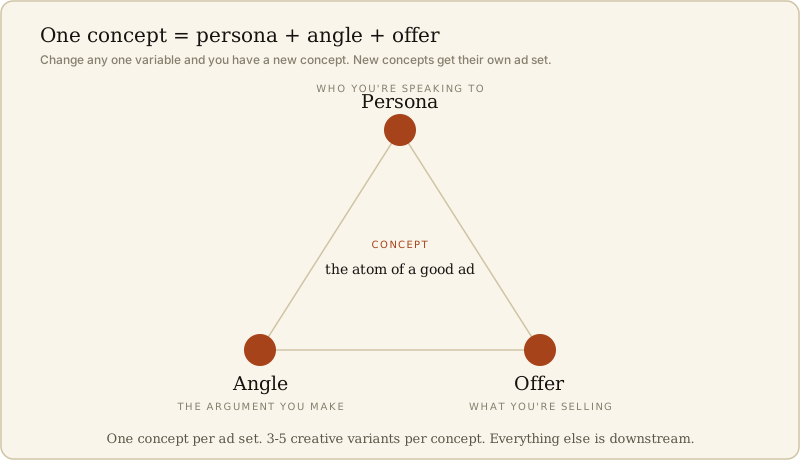
Every good ad in your account should be traceable to a specific concept, and a concept is three things: a persona, an angle, and an offer.
Persona is who the ad is speaking to. This is the person you can visualize in your head when you write the script.
Angle is the specific argument you're making to them. It's the reason a specific persona should care about a specific product right now.
Offer is what you're actually selling them. The product, the price, the promotion, the bundle, the guarantee.
Change any one of those three variables, and you have a new concept that will resonate with a different pool of people. Same skincare product with a wrinkle-treatment angle for women 45-55 is a completely different concept from that same product with an acne-recovery angle for women 25-30. Same brand, two entirely different creative concepts, two entirely different audiences.
The reason this matters for account structure: you want one concept per ad set. If you put multiple concepts into a single ad set, Andromeda gets confused about who to target and performance drops. If you put a single concept across multiple ad sets, you're splitting the same audience and hurting your data velocity.
Naming convention I use: [Persona] - [Angle] - [Offer] at the ad-set level, and each concept ad set holds 3-5 creative variants that all deliver the same concept in different formats. That gives Andromeda enough variety within the ad set to prevent frequency issues, without ever confusing which audience the ad set is targeting.
The reason people fail at concept architecture: they don't do the persona work upfront. They jump straight to "let's shoot some UGC" and end up with a folder of ads that don't map to any specific person. Then when the ads underperform, they can't diagnose why, because there's no concept to test against.
Persona first. Everything downstream depends on it.
Persona work: get painfully specific
The biggest mistake I see in persona work is that people stay too broad. "Busy professional." "Health-conscious parent." "Millennial woman." These are demographic buckets, not personas. You cannot write a good ad for a demographic bucket.
A real persona is a specific person with a specific problem, in a specific circumstance, with specific things they've already tried. When you can visualize them clearly, the script writes itself.
Compare the two examples below.
Bad persona: Busy professional woman, 25-45, needs clothes that work for multiple situations.
Good persona: A consultant who flies twice a week, needs a carry-on wardrobe that works for boardrooms and hotel bars, and has given up on department stores because nothing fits right after a 6am flight.
Look at what the good version does. It tells you who the person is (consultant), what their life looks like (flies twice a week), what they need (carry-on wardrobe), what specific situations they're dressing for (boardrooms and hotel bars), and what they've tried before (department stores). You can hear the ad in your head before you've written a word.
Same for a supplement brand.
Bad persona: Health-conscious parent.
Good persona: A mom in her mid-thirties who's tried six different vegetable-hiding tricks because her toddler won't eat greens, is skeptical of "kids' vitamins" because most of them are candy, and is worried the picky eating is affecting her kid's growth.
You could write 20 ads for that persona right now. You couldn't write one that resonates for "health-conscious parent."
My method for building a persona list:
- Start with existing customers. Look at your last 100 purchasers. What patterns show up?
- Split each pattern by problem. "Women 30-40" is a demographic. "Women 30-40 dealing with post-partum weight retention" is a persona.
- Get to 20 personas manually before you use AI. AI can help you expand from 20 to 40, but it will average out to the same generic personas everyone else's account has if you seed it with three vague buckets. Do the initial work by hand.
- Pressure-test each persona. If you can't write two paragraphs describing their exact life circumstance, it's not specific enough yet.
Then, when you write creatives, each one targets exactly one persona. Not "women 30-40," but the mom with the picky toddler. That's how you get creatives that resonate deeply and hold ad spend.
Angle work: six tactical elements every angle needs
Once you have the persona, the angle is the argument you make to them. Written out in one or two sentences, the angle should be: "for [persona], [product] solves [problem] because [specific reason]."
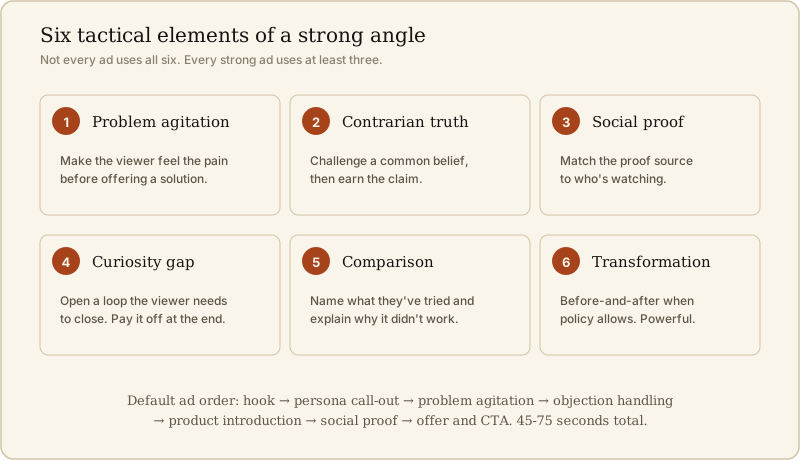
Six tactical elements go into a strong angle. Not every ad uses all six, but every strong ad uses at least three.
1. Problem agitation. Make the viewer feel the pain before you introduce the solution. If they're problem-aware, agitate the problem specifically. If they're not yet problem-aware, this is where you make them aware. Bad: "Our skincare works great." Good: "You've probably noticed the difference in how your skin looks first thing in the morning versus by noon. That's because most skincare stops working after six hours."
2. Contrarian truth. Challenge a common belief the persona holds. "Everything you've been told about protein powder is wrong" as a hook, then earn the claim with the rest of the ad. This works especially well for supplements, skincare, and any category with a lot of received wisdom.
3. Social proof. Reviews, case studies, testimonials, third-party mentions. The key is that the proof needs to be specific to the persona. A doctor in a lab coat is meaningless for a running product. A marathoner talking about their weekly mileage is proof. Match the proof to who you're speaking to.
4. Curiosity gap. Open a loop the viewer needs to close. "Here's what the top 1% of parents know about picky eating that pediatricians don't tell you" is a hook that opens a gap. You don't answer it immediately. You walk through the story, cover the other elements, and only pay it off near the end of the ad. This is how you hold attention through a 60-90 second video.
5. Comparison or objection handling. Your viewer has probably tried other things. Address that head-on. "You've tried the vitamins, the hidden-vegetable purees, the bribery. Here's why none of that worked." Then you introduce your product as the thing that solves the reason those other things failed.
6. Transformation. Before-and-after. Meta's ads policy makes this tricky for a lot of categories, especially in health, beauty, and finance. But when you can find a compliant way to show a real before-and-after, it will out-perform almost every other element. Consider it a bonus tool, not a default.
The order these appear in an ad matters. My default rough structure for a UGC-style ad:
- Hook (usually curiosity gap or contrarian truth)
- Persona call-out (so Andromeda knows who to serve to)
- Problem agitation
- Objection handling or comparison
- Product introduction
- Social proof
- Offer and CTA
Total runtime, 45-75 seconds. Longer for high-consideration products, shorter for impulse-buy categories.
Hooks: the first 3 seconds decide everything
The single most important thing in the entire ad is the first three seconds. If you don't get someone past three seconds, nothing else in the ad matters. It doesn't matter how good the copy is at second 30 if 90% of your audience is gone by second 5.
Your hook has to do two things at once. It has to be interesting enough to make someone stop scrolling, and it has to signal to Meta who this ad is for so Andromeda can serve it to the right audience.
Best hook structures I've watched work in 2026:
Persona call-out plus curiosity. "If you're a mom with a toddler who won't eat vegetables, watch this before you buy another supplement." Names the persona, opens a gap, gives them a reason to watch.
Contrarian claim. "You're being lied to about protein powder." Direct, controversial enough to stop the scroll, sets up the rest of the ad to explain.
Specific number in the first sentence. "I lost $47,000 on Meta Ads last year before I figured out what actually worked." Specificity is what makes it feel real.
Visual pattern interrupt. Something on screen in the first frame that doesn't look like an ad. A messy kitchen, a real bathroom mirror, a person in mid-sentence.
Hooks I would never use in 2026:
- "Hey everyone" (generic, no persona call-out, algorithm has nothing to work with)
- Product on white with a floating price tag (looks like an ad, immediate scroll)
- Any hook that starts with the brand name (audience doesn't know the brand yet, so it's meaningless)
If you produce 100 ads a month and 20% of them get to a 30% video-view rate, you're winning. If 5% of them do, your hooks are wrong and every other tactical improvement in this guide will underperform. Fix the hooks first.
Ad-set structure, sequencing, and reading the data correctly
This is the section where most people mess up their account structure and then blame the algorithm.
The correct structure for almost every account under $500k a month:
- One or two campaigns. ASC (Advantage Shopping Campaign) or a Sales campaign. Advantage+ audience on.
- 6-12 ad sets per campaign. Each ad set is one concept (persona-angle-offer). Ad set budget between $50-200 a day, depending on total spend.
- 3-5 ads per ad set. All variants of the same concept in different formats or executions.
- Exclusion audience: existing customers. Don't waste retargeting spend on people who already own the product.
That's it. No interest targeting. No lookalikes. No age-and-gender splits. The account is broad and simple, and all the diversification happens in the creative.
Now the part almost everyone gets wrong.
Meta's attribution is last-click. That means the last ad the user saw before they bought gets 100% of the credit. But Meta's actual budget allocation is multi-click and multi-view. It sees users bouncing between ads across your account, and it distributes budget to the ads that play a role in the sequence, even if they're not the ad that gets the click.
Practical consequence: when you look at your ad-level ROAS numbers, the top-of-funnel ads look terrible. They have low ROAS because they don't get the last click. The bottom-of-funnel ads look amazing because they inherit all the attribution. The instinct is to turn off the top-of-funnel ads.
Don't do that. If you do, you kill the sequence, and within a week the bottom-of-funnel ads that looked amazing will collapse because they no longer have upstream ads warming users up.
The rule: make decisions at the ad-set or campaign level, not the ad level. Ad-level ROAS is unreliable because it doesn't capture the multi-touch journey. Ad-set-level ROAS is much more reliable. Campaign-level ROAS on 7-day click attribution is nearly identical to what shows up in your P&L, as long as you exclude existing customers.
What that means in practice:
- If an ad set is hitting your target ROAS overall, do not turn off individual ads inside it, even if their individual ROAS looks bad. Meta is sequencing them on purpose.
- If an ad set is below your target ROAS overall, the whole concept isn't working. Kill the whole ad set, not individual ads. Then build a new concept.
- Only judge new creatives after they've had at least $200-500 in spend. Below that, you're reading noise.
When you follow this structure, your ad account calms down. You stop making 15 changes a week trying to chase ROAS numbers, and you start letting the algorithm do its job while you focus on the actual lever, which is producing more good creative.
Volume math: how many ads you actually need per month
The last piece is production volume. How many creatives do you actually need to produce every week to run this system?
The rough formula I use: you need enough creatives to keep 6-12 concepts active in the account, with 3-5 variants per concept, and you need to replace fatigued concepts at the rate they fatigue.
Concept fatigue rates vary by industry and by how good the concept is, but a typical strong concept lasts 6-10 weeks before it needs a variant refresh, and 3-4 months before it needs a full replacement.
Turning that into numbers, for an account spending between $30k and $150k a month, you're producing somewhere between 30 and 80 new creatives per month, of which maybe 8-12 are net-new concepts and the rest are variants of existing concepts.
Creative production budget as a percentage of ad spend, which is the metric most brands underinvest against: I aim for creative production to sit around 8-15% of ad spend. Below 5% and you're guaranteed to run out of variants. Above 20% and you're probably producing too much of the wrong stuff.
Here's the concentration mistake to avoid: producing 2,000 new ads a month on a $250k budget. I've seen this recently at two accounts, and both were losing money. Massive volume with no concept discipline is not strategy. It's activity. The right number for a $250k budget is closer to 60-100 new creatives a month, all mapped to specific concepts, all quality-controlled.
The exception is a brand testing a genuinely new category or product. There, you can justify higher volume in the first 30-60 days while you're figuring out which concepts land. Even then, you're not launching 2,000 ads. You're launching 200 concepts and looking for the three that hold spend.
Volume without strategy is expensive noise. Volume with strategy is compounding growth. Get the strategy right first, then scale the volume.
The creative production team, and how I run it with agents
The last piece is who's actually making all this creative. If you're running Meta Ads at any serious scale, you need a repeatable production process. The version I run in 2026 leans heavily on agents, but the human roles still matter.
Three human roles that don't go away:
Creative strategist. This is the person who owns concept architecture. They do the persona work, they write the angle briefs, they choose which formats to shoot. This role cannot be automated. It requires actually understanding the customer, the product, and the category, and making judgment calls about what will resonate.
Producer. The person who takes briefs and turns them into shot content. In 2026, this can be one person plus a network of UGC creators, a small in-house team, or an outsourced production shop. What used to require a full production crew now often requires one good producer and a few days of shooting per month.
Ad account operator. The person who launches, monitors, and structures the account. This role is smaller than it used to be, because most of the decision-making has moved into structure and out of daily tweaking. Ten hours a week for a $100k a month account is realistic.
The agent layer wraps around all three:
- Concept research. A well-briefed research agent can pull competitor ads, review-site language, customer transcripts, and Reddit threads about the category, and hand the strategist a document with 30 persona sketches and 40 angle candidates in an afternoon. That work used to take a week.
- Script drafting. Once the strategist locks personas and angles, an agent can draft 10 script variants per concept in the strategist's voice. The strategist edits and green-lights, then the producer shoots.
- Ad account audit. Weekly, an agent can pull the account's frequency, similarity score, top and bottom concepts, and flag issues. The operator reviews the flags, makes calls, and moves on.
That stack means one strategist plus one producer plus one operator plus agents can run the creative machine for a brand spending up to about $200k a month. That used to take a team of 6-8 people.
If you want to see the shape of that stack in more detail, the full AI stack I run today is on the home page. What the output looks like across a week sits in the section below that. More detailed breakdowns of specific plays like this one are in Writing.
The takeaway: creative is now the only Meta Ads lever that matters. If you get the persona work right, produce enough variety to keep frequency down, structure the account so Andromeda can do its job, and read the data at the right level, you'll compound. If you skip any of those, you'll spend 2026 wondering why your CAC keeps going up.