Every marketer I've talked to in the last six months has said some version of the same thing: nothing lands anymore. The posts don't get engagement. The emails don't get opens. The ads don't convert. The playbook hasn't changed. The results have.
The reassuring part is that you're not doing anything worse than you were doing two years ago. If anything, you're doing it better. Your creative is sharper, your targeting is tighter, your production is faster.
The uncomfortable part is that the playbook you're running was built for a world that isn't there anymore. Every fix people are selling you (post more, automate more, let AI carry the load) is making the problem worse, because the problem isn't execution. The ratio underlying every marketing channel has flipped, and no amount of tactical polish fixes a broken ratio.
Here's what happened, why it happened, and the three moves I've watched still cut through.
It's not your marketing that broke. It's the world it was built for.
The playbook that worked between 2019 and 2023 assumed there was room in the market. Room in the inbox. Room in the feed. Room in the browser tab your prospect had open. Every tactic underneath that playbook (write a good subject line, ship a landing page, run a targeted ad, publish weekly on LinkedIn) worked because the underlying assumption was still true. There was space for one more good thing.
The assumption is no longer true. And most marketing playbooks haven't caught up.
The reason most marketing feels like pushing on a locked door in 2026 is that the door isn't locked because your key is wrong. The door is locked because the room on the other side is already full.
The stuff-to-attention ratio, and how it inverted
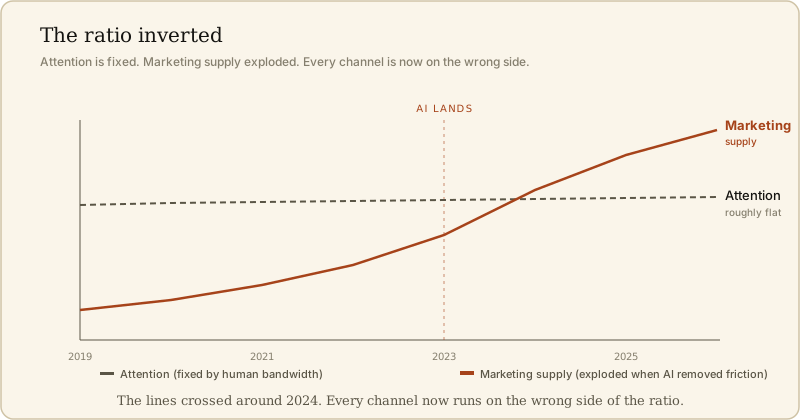
Every marketing channel runs on the same underlying equation: how much attention is available in this channel, versus how much stuff is competing for it. When attention outweighs stuff, the channel is a growth engine. When stuff outweighs attention, the channel is dead, and no amount of tactical polish resurrects it.
For roughly a decade, the ratio was in your favor. Newsletters, LinkedIn, X, Google Ads, cold email, YouTube. Every channel went through the same three phases. A pioneer phase where the space was empty and even mediocre execution got real traction. A copycat phase where the ratio tightened but stayed workable. A saturation phase where the ratio inverted and everyone still running the old playbook wondered what changed.
The pattern shows up in almost every dataset. There are roughly 2.4 million apps on the App Store. Your phone has 30-50. That gap isn't a discovery problem. It's a bandwidth problem. There are only so many hours in the day, only so much money in the pocket, only so much attention in the brain. Once every channel fills past that ceiling, the presence of more good stuff stops mattering, because "good" can't break into consciousness that's already full.
The specific accelerant of the last 18 months is AI, which removed every remaining friction in creating marketing content. Writing was hard: now it isn't. Design was hard: now it isn't. Video was hard: now it isn't. Volume was hard: now it isn't. Every channel filled in the specific order that AI removed friction from. Text feeds first (X, LinkedIn text posts). Image feeds next. High-production video is the last holdout, and it's tightening this quarter.
The result: every channel you're touching in 2026 is on the wrong side of the ratio. Stuff outweighs attention by a factor most marketers still haven't internalized. Which means the assumption underneath your entire playbook (there's space for one more good thing) is broken.
The playbook doesn't need better execution. It needs to be replaced.
AI didn't start this. Twenty years of removing friction did.
It's tempting to blame AI for the collapse. AI is the visible acceleration and the easy villain. But AI is the finisher, not the cause. The underlying flood has been building for twenty years.
Zoom out on two decades of "business progress" and ask what actually got built. Email replaced letters. One-click checkout replaced shopping-cart flows. Video calls replaced flights. Templates replaced custom design. Automations replaced manual workflows. No-code replaced engineering. AI now replaces most of what's left.
None of that is genuinely creative. None of it introduced categories that didn't exist before. Every one of those advances is an attack on the same thing: friction. The same activities, faster, cheaper, easier to execute.
The pitch was always liberation. If we remove friction, people are freed to think and create and do the meaningful work. In practice, removing friction floods everyone with the sludge the friction was holding back. More emails. More meetings. More apps. More subscriptions. More companies. More marketing. More of everything, all of it competing for the same fixed pool of attention.
Friction was doing quiet work we underestimated. It forced discipline. If a piece of marketing cost real money and real time to send, you'd think harder about whether the piece was worth sending. If launching a product took two years, you'd interrogate whether the product was worth two years. If publishing a book required getting past a real editor, most books that shouldn't exist wouldn't.
Friction protected our customers too. It kept them from being hit with 60 subscription pitches and 400 marketing messages before lunch. It preserved the ratio in their favor without anyone having to enforce it.
Take the friction out and the market floods. Take the friction out and the customer's plate overflows. Take the friction out and the "good" thing you just made becomes indistinguishable from the 200 mediocre things everyone else made using the same tools you used.
The rule that falls out of this is uncomfortable but clean: if it's not difficult, it won't work. Difficulty is the requirement, not a bonus. Anything easy is, by definition, abundant. Anything abundant is, by definition, worthless.
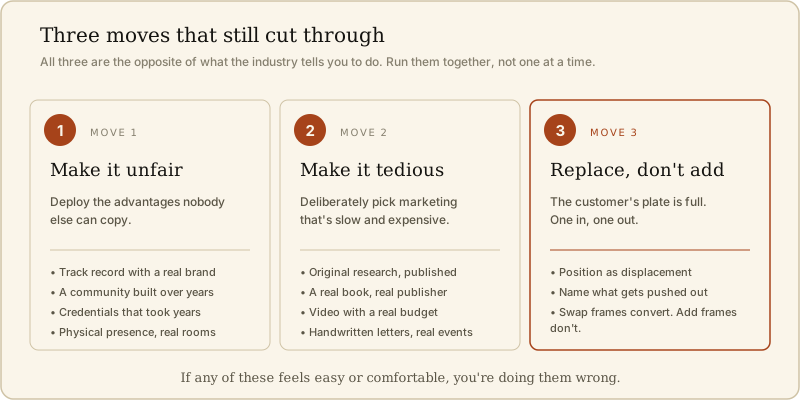
That rule has three implications. Three moves I've watched still cut through in 2026, all of them the opposite of what the industry is currently telling you to do.
Move 1: Make it unfair (deploy the advantages nobody can copy)
If ease is the enemy, the first move is to stop competing on things anyone can now do and start deploying whatever unfair advantages you have that nobody can replicate.
For years, the "creative" advantages that worked were: I can write well, I can design well, I have taste, I can produce at volume. Every one of those is now a commodity, because AI can produce all of them at scale for anyone with a Claude subscription. What isn't a commodity: your specific circumstances, your specific connections, your specific track record, your specific access. AI can't hand your competitor a copy of your background overnight.
Concrete versions of unfair advantages I've watched work in the last year:
- A track record with a specific brand or role. "I was the third person on the growth team at a company you've heard of" is not a claim AI can fake for a competitor.
- A specific credential that took years to earn. PhD, JD, MD, licensed practitioner. Boring, hard-won, uncopyable.
- A community you've spent years building. If a competitor could snap their fingers and have 400 CEOs in a private group, they would. They can't.
- A physical presence. Real speaking gigs, real events, real people who've met you in real rooms. The ratio-flip hasn't touched the physical layer.
- An association nobody can invalidate. "I was the coach who worked with a founder you've heard of" is worth more than any content you could produce, even if the relationship was informal.
The question I run through when I'm thinking about a new project: what is true about my situation that nobody could copy, and how do I put that at the center of the work? Every time I've made the mistake of leading with "what's a good hook" instead, the answer has been forgettable.
Most people have at least one of these advantages if they look honestly. The failure mode is either underestimating what they have or being embarrassed to use it. If your only advantage is that you've worked in one specific corner of insurance for twelve years, put that at the center. Twelve years is a real moat now. Nobody is vibe-coding their way to twelve years of experience.
The teams I've watched grow past their peers in 2026 all lead with something like this. The teams stuck at the same level are still trying to compete on tactics anyone with a Claude subscription can execute.
Move 2: Make it tedious and expensive (friction is the moat)
If move one is about deploying uncopyable advantages, move two is about deliberately picking marketing that's uncomfortable to execute. Slow. Expensive. Boring. Painful.
The instinct in a saturated market is the opposite: cut cost per unit, ship more per hour, automate the boring parts. That instinct is now a trap. Every "efficiency win" you take moves your work into the abundant-and-worthless category. Every uncomfortable investment you make moves it into the scarce-and-valuable one.
Concrete versions of tedious-and-expensive that I've watched still pay:
- Commission original research and publish it. Not a compilation of stats. Not a "here's what the data says" listicle from public sources. Actual primary research with a methodology, a sample size, and a real conclusion.
- Grind out a serious speaking calendar. I know a consultant who did fifty speaking slots in one year. Every one of them was work. Her business is now defensible because nobody else is putting in that level of physical effort.
- Write a real book and get it published by a real publisher. Not a self-published PDF. Not an AI-drafted ebook. A book that had to pass an editor.
- Produce video at a level that requires a real crew and a real budget. Not phone-in-hand, not screen recording. Production values that signal you spent money.
- Run your own events. Real rooms, real people, real coffee. The room itself is the moat.
- Send handwritten letters to prospects. Same words as an email, entirely different response rate, because the recipient can feel the friction.
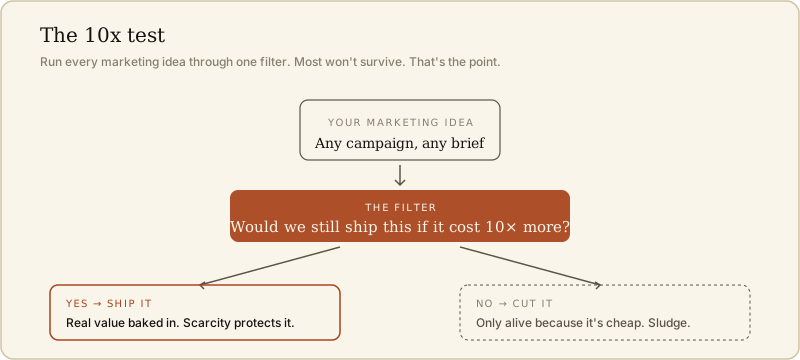
I run one filter on every marketing idea now: would we still ship this if it cost ten times more than it does today? If yes, the idea has real value baked into it and scarcity is protecting it. If no, the idea is only alive because it's cheap and easy, which means everyone else can do it too and nobody's paying attention.
The filter kills most of what's on any marketer's current plan. That's the point. What survives after the filter is the work that actually moves the metric.
There's a related trap worth naming. Most of the market has been trained to want marketing "for free." Every content-marketing playbook, every LinkedIn ghostwriting service, every "how to grow on X" thread has convinced people that the right answer is always cheaper. The moment you're willing to actually pay for distribution or production, most of your competition disqualifies itself. Being willing to spend real money on something the industry says should be free is itself a scarcity play.
Not everyone can do this. That's the whole point.
Move 3: Replace, don't add (the customer's plate is full)
The third move is quieter than the first two, but it changes how you frame every campaign brief.
The customer's plate is already full. Their inbox is already full. Their phone is already full. Their attention is already spoken for. Which means when you frame your marketing as "here's one more useful thing to add to your life," you're competing for space that doesn't exist. There is no in. You're being politely ignored because there's no room, not because the thing you made is bad.
The framing that actually works is displacement. "We're the thing you're going to use instead of the thing you're using now." "We're the tool that replaces three of the tools you already have." Displacement forces the customer's brain to swap, not to add. Swapping is a workable decision. Adding is impossible in a full plate.
Two examples I keep coming back to. Liquid Death didn't ask people to drink one more beverage. It gave them a more arresting alternative to bottled water they were already drinking. Trader Joe's didn't ask customers to add one more shopping trip. It replaced other grocery runs by being distinctive enough to stand alone.
Same shape at a smaller scale for a SaaS play. The tool that positions itself as "the replacement for HubSpot" gets attention that the tool positioning itself as "another CRM option" doesn't, even when the products are comparable.
The question to run through when you're framing a new campaign or a new landing page: what specific thing that currently occupies the space we want gets pushed out if we succeed? If you can't name the thing you're displacing, you're marketing additively into a saturated plate. The campaign is dead before it launches.
The one line I keep coming back to
The line I've been saying to every founder I talk to this year: if it's not difficult, it won't work.
That line is doing a lot of work. Every other post I've published on this site is a specific version of the same underlying pattern. Pull GTM beats push GTM because push is easy and everyone does it. Software isn't a moat because software is easy to copy and getting easier. A face on the brand works because being a real recognizable person over years is hard and can't be shortcut. Picking boring industries pays because most founders won't do it.
The meta-thesis under all of it is the same. The marketing that still works in 2026 is the marketing most people won't do.
The reassuring version of that line: your competitors aren't going to do the hard thing. They're going to read the same articles you read about "10x your output with AI" and produce more sludge into the same saturated channels. They'll be busy for the next 18 months. You have a window if you use it right.
The uncomfortable version: the hard thing has to actually be hard. Not "hard in theory." Not "hard for a few weeks then automated." Actually hard for as long as you run it. Because the moment the hard thing gets easy, it stops being scarce and stops working.
If you want to see how I try to run this in practice, the current AI stack lives here. More posts in this shape live in Writing. Every one of them is another angle on the same rule. If it's not difficult, it won't work. Everything else is table stakes for a game nobody's winning anymore.