The traditional monthly content refresh cadence doesn't work for AI search. Ranking flat on Google is a slow-moving problem. Losing 16.7% of your ChatGPT citations in a single week is a different problem entirely, and the workflow you built for the first one doesn't catch the second.
I've been paying close attention to how the fastest-moving brands are running content refresh for AI search in the last quarter, and the shape of the engine is consistent enough to describe as a playbook. Six sections. Roughly the order I'd build them.
If I were setting this up today for a brand that cares about AI search visibility, this is exactly the loop I'd run.
Why weekly SEO refresh cadences don't work for AI search
SEO refresh cadences were built for a signal that moves slowly. Rankings drift by 2-3 positions over weeks. Traffic dips over months. You had time to notice a problem, investigate it, ship a fix.
AI search moves faster. Model updates land weekly. Retrieval patterns shift when a competitor publishes fresh content that the model prefers. Your citation rate on a specific query can drop 15-20% in seven days, and by the time your monthly SEO report catches it, three more topics are already in decline.
The bigger issue is that the signal you were tracking (ranking per keyword) isn't the signal that matters anymore. What matters now is:
- Mention rate: what percentage of AI answers for a given query mention your brand at all
- Citation rate: what percentage of AI answers actually cite your specific URL as the source
- The gap between them: how often the model knows about you but chooses someone else's page as its source
That third metric is the actionable one. Weekly cadence is fine. Changing the signal you're refreshing on is what unlocks everything else.
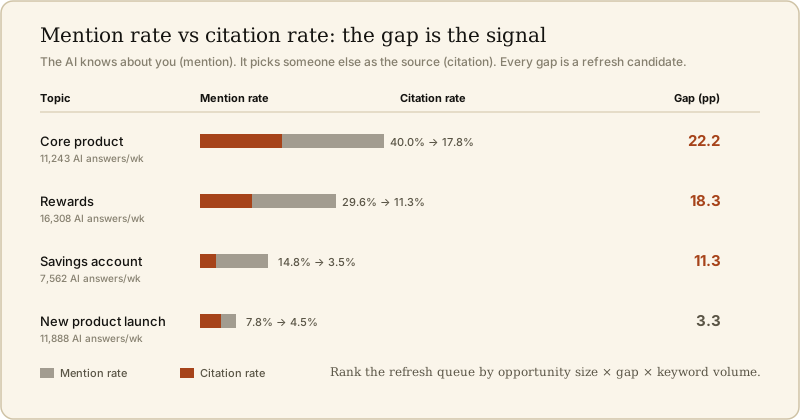
Track mention rate vs citation rate. The gap is the signal.
Every content refresh decision I've watched work in the last six months starts here. You pull a set of 50-100 prompts per topic (savings accounts, credit cards, whatever your category is), run them against ChatGPT / Claude / Gemini weekly, and score two numbers per topic:
- Mention rate: brand appears anywhere in the answer
- Citation rate: your specific URL is cited as a source
The gap between those two is your priority queue. Consider a real shape I've seen recently:
- Topic A: 40% mention rate, 17.8% citation rate → 22.2 pp gap
- Topic B: 29.6% mention rate, 11.3% citation rate → 18.3 pp gap
- Topic C: 14.8% mention rate, 3.5% citation rate → 11.3 pp gap
Every one of those gaps is a page that's losing to a specific competitor at the retrieval layer. The AI knows about the brand. It doesn't pick your page as the source. Something in the content is weaker than the alternative sitting in the retrieval index.
Alerts I'd fire on:
- A sudden citation-count crash (more than 15% week-over-week)
- A mention-citation gap widening by 5+ percentage points
- A new competitor URL appearing in the top 3 citations for a prompt you own
You can instrument all of this in a spreadsheet before adding a paid tool. The spreadsheet is not the bottleneck. The bottleneck is doing the work weekly and letting the signal drive prioritization.
Rank refresh candidates by three factors, not one
Once signals start firing, you'll have more refresh candidates than the team can execute on. Prioritize with three factors:
- Opportunity size. Rank by total surface area you're losing across AI answers, not raw decline percentage. A topic with 16,308 AI answers per week and a 18.3 pp gap is worth more than a topic with 200 answers and a 40 pp gap.
- Decline severity. How much your citation rate dropped week-over-week or month-over-month. Bigger declines are easier refresh candidates because the fix is directional (bring it back to the previous level). Novel gaps take more experimentation.
- Keyword volume. Traditional SEO check. Don't refresh a page nobody searches for, even if the AI-answer volume is high. The two signals need to agree.
Combine all three, sort, take the top 5-10 per week. That's your refresh queue.
Two guardrails I'd add on top of the ranking:
A 60-day exclusion rule. If a page has been refreshed in the last 60 days, exclude it from candidate consideration. Without this rule, borderline-declining pages keep re-entering the queue every week and the team ends up refreshing the same three pages every month while the rest of the site rots. Bake the exclusion into the ranking step, not a manual review.
A URL slug filter. Only editorial content should be in the refresh queue. Filter to folders like /blog/, /insights/, /resources/, /articles/, /learn/. Product pages, pricing, and legal don't belong here. If your CMS doesn't organize URLs cleanly, use content-type signals from your brand knowledge base instead of raw slugs.
The output of this step is a ranked shortlist. Every row on the shortlist has a topic, a page URL, the specific decline signal (which citation dropped, by how much, over what period), and a prioritization rationale (why this topic beat the others on the three factors).
Write refreshes with the rationale baked into the brief
The failure mode I've watched destroy the most refresh engines: a page URL and "please update this article" land in a writer's queue with no other context. The writer adds three paragraphs, hits publish, nothing moves. Two weeks later the citation rate hasn't recovered. Everyone concludes the refresh engine doesn't work and goes back to guessing.
The problem is the brief. A good refresh brief has three specific things:
1. The specific decline signal. Not "please improve this article." Something like: "This page's citation count dropped from 112 to 94 in the last week (-16.7%). Cited prompts dropped from 24 to 21 (-12.5%). Citation rate is now 0.03%, down from 0.05%."
2. The specific gap being addressed. Not "make it better for AI." Something like: "Mention rate is 14.8% but citation rate is 3.5%. The AI knows about the brand for this topic. It's picking a competitor's page as the source. The competitor page (URL provided) leads with a specific claim that ours buries in paragraph 6."
3. The specific claim to reinforce. This is where most briefs stop, and it's the part that moves the metric most. If the AI is mis-citing a specific number, rewrite headings and structure so the correct number appears in multiple H2s. If the year matters ("best banks 2026"), get "2026" into 4-5 H2s across the article. If the page is failing because a specific product tier or feature name isn't showing up in the content, name it early and often.
I watched one team fix a 578% citation crash on a payday-advance-apps page by doing nothing except adding "2026" to five H2s and reinforcing one specific counter-claim about competitor apps. The citation rate recovered within two weeks. The rewrite was less than 40% of the article's original word count.
The brief should also carry: brand voice guide, competitive analysis specific to this topic (not brand-wide), and links to the top-cited competitor URLs. All context the writer needs to write a refresh that actually moves the metric.
Route through compliance without breaking the loop
Most brands I work with are in regulated industries: fintech, health, insurance, banking. Every published content change has to pass compliance review. Compliance latency is 2-5 days at best, sometimes two weeks. That latency will kill your refresh engine if you build the loop wrong.
The pattern that keeps the loop alive:
- Refresh output writes to a staged Google Doc, not a published page
- The Google Doc integration creates a Jira ticket for compliance review
- Compliance reviews inside Jira, approves or requests changes
- Approval triggers the publish step (manual click or automated)
- Measurement instrumentation kicks in 2 weeks after publish
The reason this works is that compliance never sits inside the signal or ranking phases. Signals get pulled and ranked continuously by the engine. Compliance only touches the output. Which means the engine keeps running even when compliance is bottlenecked.
If compliance is the bottleneck for you, the fix is queue depth, not workflow speed. Stack 3-4 weeks of refreshes in the Jira queue so approval latency doesn't stall the engine. Compliance operates on their timeline. The engine operates on its own.
What I'd actually build with this
The version of this I'd build looks like:
- Signal layer: weekly pull of mention rate + citation rate across 50-100 prompts per topic. Spreadsheet or lightweight tool at first.
- Prioritization layer: three-factor ranking, 60-day exclusion, URL slug filter. Runs on a schedule (Monday 9am is fine).
- Writing layer: refresh-brief template that carries decline signal, gap, and specific claim to reinforce. Writer never sees a bare URL without context.
- Compliance layer: Google Doc → Jira → publish gate. Queue depth of 3-4 weeks.
- Measurement layer: track citation rate 2 weeks post-publish for each refresh. Feeds back into signal-layer priorities.
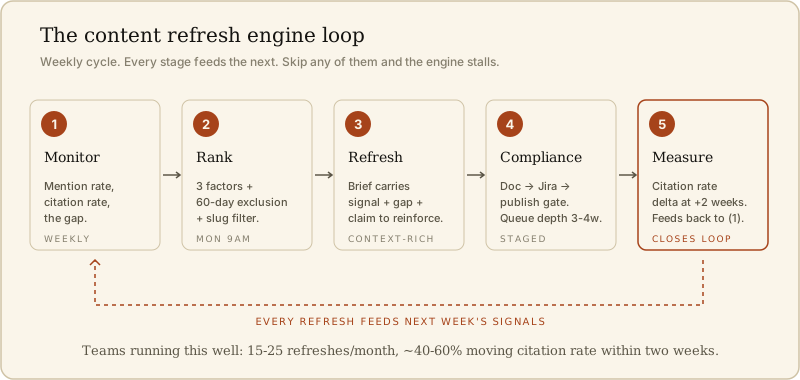
The teams I've watched run this well pull 15-25 refreshes per month with roughly 40-60% moving the citation rate meaningfully within two weeks. That's a real growth channel, and it compounds because every successful refresh raises your ratio of "cited pages" across the site.
The teams still refreshing "when traffic drops" or "based on gut feel" are 12-18 months behind by the end of 2026. The gap widens every quarter until they build the loop or their AI-search share gets eaten by a competitor who did.
If you want to see the underlying stack that makes this runnable by a small team, the current AI stack lives here. More long-form posts in this shape live in Writing.