I read a lot of "how X grew" content and most of it is noise. The story is either survivor bias dressed up as a lesson, or the founder credits some specific tactic that only worked for them.
Every once in a while, though, a pattern shows up too many times to be an accident. Over the last 18 months I've been paying close attention to the fastest-growing AI startups (mostly YC alumni like Corgi, Legora, Candid Health, Areni, Sim, Goji Berry, and PlanGrid), and every single one of them is running the same four moves.
Same order, same emphasis, same non-negotiables. The details vary. The playbook doesn't.
Here it is, plus the reason it works better in 2026 than it ever has.
The four moves I keep seeing
The playbook, in one sentence: pick a boring industry, get pathologically close to your customer, run content only your ICP would care about, then close the 95% iceberg with warm outbound.
Each step feeds the next. Skip any one of them and the machine stalls. Do all four in order and you get a company that goes from zero to $40 million ARR in two years without a fancy marketing team.
The reason the playbook stays consistent across companies is that the underlying math is the same. Distribution is scarce. Software is cheap. Customers are hard to reach unless you find a channel that reaches them for free. All four steps are what falls out when you take that constraint seriously.
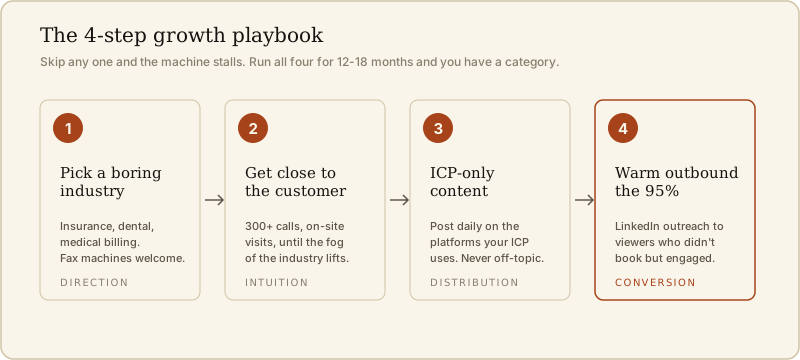
Here's the breakdown.
Step 1: pick a boring, ancient industry with fax machines
Every founder I've watched succeed in the last two years picked a fight most people would call unglamorous.
Corgi went into insurance. Insurance is roughly 12% of GDP, roughly twice the size of the entire software industry, and every incumbent runs on fax machines. Legora went into legal. Their two founders didn't have law degrees. Candid Health went into medical billing and denied claims. Areni rebuilt the front reception desk of dentist offices. PlanGrid sold to construction workers and closed for $875 million.
Notice the pattern. None of these are "software for software people." None of them compete with Cursor or Lovable or the other AI dev tools that fight for the same 500,000 engineers on the same 5 platforms. They compete with 60-year-old carriers using paper forms.
The reason this matters is competitive intensity. If you build another dev tool, another SaaS dashboard, another AI wrapper for an audience that already knows how to use AI, you are in a bloodbath against the smartest, most well-funded, most caffeinated engineers on the planet. The unit economics work against you before you write a line of code.
If you build for insurance brokers, dental receptionists, medical billers, construction site managers, or any of the other 30 industries that still run on fax machines and Excel, you walk into a room where you are the only modern company. The buyers have been waiting a decade for someone to build something that isn't 15 years old. Being present is the whole bar.
The direction you pick is 90% of the game. If you pick wrong, no amount of grinding on the other three steps will fix it. If you pick right, the other three steps compound into a category-defining company in three years.
My rule when I look at a startup pitch: if the founder can name three competitors under the age of five, the market is too crowded. Go somewhere the competition is measured in decades.
Step 2: get pathologically close to your customer
Every one of the fast-growing founders I've watched has the same move once they've picked an industry. They talk to customers for months. Not for weeks, not for a batch of 20 calls to "validate." Months. Daily. Until it feels excessive.
The founder of Sim spent his first four months on calls almost every day, sometimes ten calls a day, walking users through the product. The Corgi and Legora founders sat physically inside customer offices, watching people work, taking notes on what they clicked and what they printed. The PlanGrid founder famously showed up at construction sites with boxes of donuts and asked construction workers what they hated about their day.
There's a specific mental model that makes this feel less crazy. Think of the customer's problem space as a Battleship grid. When you enter the industry, the entire board is fog. You cannot see where the real problems are. You have guesses, but your guesses are wrong.
Every customer conversation clears the fog on one small part of the grid. Most conversations don't lead to a product decision. You take a shot, you learn what isn't a problem, you keep going. After 20 conversations you know where the fog is thickest. After 100 you have a rough map. After 300 you have expert-level intuition on a problem space that industry veterans have been staring at for 30 years but never zoomed out on.
That expert-level intuition is your edge. Not your technical stack. Not your speed of shipping. Your intuition about where value actually lives in a specific customer's world.
You only get that intuition one way: sitting across from real users with something in your hand (a product, a Figma mock, a Google Doc) and watching how they react. Reading about the industry gets you the surface. AI summaries of Reddit threads get you a slightly deeper surface. Neither gets you the pattern you need for a real product decision.
The founders who skip this step build products for the customer they imagined. The founders who do it build products for the customer that actually exists. In every category I've watched, that difference is worth $500 million in enterprise value.
Step 3: content that only your ICP would care about
Once you have the intuition, the question is how you actually reach the customers you now understand. This is where most founders default to cold outbound and where the fast-growing companies do something different.
They post. Every day. On the platforms their ICP uses.
I want to be specific about what this content looks like, because "just post more" is bad advice. What actually works is content that is aggressively narrow to one specific customer profile.
A post that gets 2 million impressions but hits a general audience will generate roughly zero revenue. A post that gets 20,000 impressions but hits the exact person who has the specific problem you solve can generate $6,000 in MRR from one post. I've seen this ratio play out on my own work, and every founder I've talked to who runs this play sees the same thing.
The reason is the current shape of the algorithm on X and LinkedIn. Both platforms moved from a follower-graph model to an interest-graph model over the last three years. Which means followers barely matter anymore. What matters is whether the algorithm has enough signal to know that you are an expert on a specific topic, and whether the content you post matches the interests of a specific audience segment.
Practically, that means:
- Never post outside your niche. A founder posting about their morning routine or a viral meme is training the algorithm to serve their content to a broader (worse) audience. Every off-topic post shrinks your future reach to your actual buyers.
- Post twice a day if you can. Once is fine. Zero is the mistake that kills more startups than any other content mistake.
- Study the viral posts inside your niche. What structure do they use? What hooks? What is currently on-topic and getting reach? Then remix them in your voice with the specific customer insight you've picked up from Step 2.
The math works out to something like this. Two posts a day, five days a week, on two platforms is 20 posts a week. If those posts pull an average of 3,000 impressions each (very conservative once you've been posting for six months), that's 60,000 targeted impressions a month. If 5% of those impressions belong to your ICP, that's 3,000 hyper-qualified eyeballs on your product every month, for free. Five calls a week is a normal outcome. Four closes a month at $30,000 ACV is $1.5 million a year, from a channel that costs you the time to write posts.
Founders of billion-dollar companies are running this play at 20 likes per post. They're training an algorithm to funnel their exact buyers into their sales pipeline for free. That's the whole point of the exercise, and the volume of likes is a distraction from it.
Step 4: the 95% iceberg
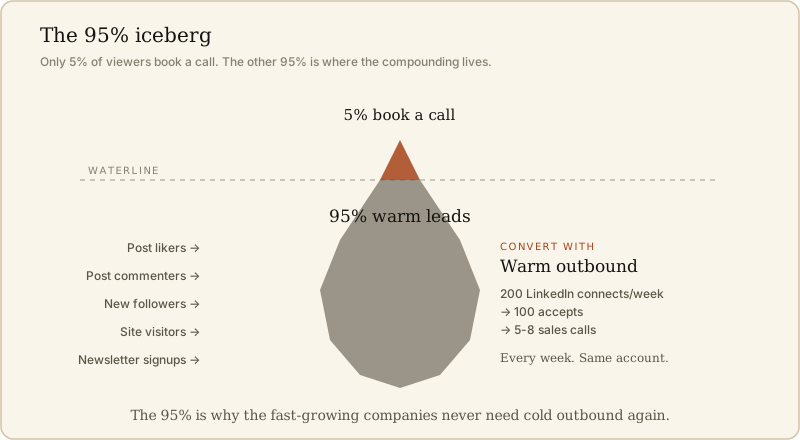
Here's what almost everyone misses about the content strategy. Only about 5% of the people who see your posts will book a call.
The other 95% are still valuable. They saw the post. They read it. Some of them liked or commented. Some of them followed you. Some of them looked at your website but didn't sign up. Every one of those signals is a warm lead. The 95% is an iceberg sitting under the surface, and the fast-growing founders have figured out how to convert that iceberg into revenue.
The move is targeted warm outbound, specifically on LinkedIn.
LinkedIn is the channel that works right now. Email goes to spam, and inbox providers penalize new senders. LinkedIn messages, especially between two people who share a mutual connection or where the recipient has already seen your content, get read at 5-10 times the rate of a cold email.
The mechanics are simple. Every week, connect with up to 200 people who fit your ICP. LinkedIn limits are around 200 connection requests per week for accounts in good standing. You want to stay under that ceiling, not blow past it.
Of the 200 you invite, roughly 100 will accept. You now have 100 new people in your network who match your buyer profile. Send each of them a short, personalized message with a specific observation about their work, tied to a problem you know they have because you've been posting about it and they've engaged.
That's 100 warm outbound touches per week, per account. At a 5-8% booking rate (typical for warm outbound done well), that's 5-8 sales meetings a week from one channel. Fast-growing companies stack this on top of the inbound from content, and the two channels compound.
Do this consistently for a year and you have 5,000+ people in your network who are aware of your product. Cold outbound stops being necessary.
Why the playbook works better in 2026 than in 2020
Here's my angle on why this specific playbook is working right now, and why every founder trying to grow a company should be running it instead of the classic "great product plus paid ads" motion.
Three things changed.
Cold outbound got worse. Everyone's inbox is 60% AI-generated first-touch spam. Response rates are half of what they were in 2020. The channel that used to compensate for a weak content flywheel doesn't compensate for anything anymore.
Social algorithms moved to interest graphs. Which means a founder with zero followers, posting the right content, can now reach thousands of exact-fit buyers in month one. In 2020 this required a huge following. In 2026 it requires a good post and a clear ICP.
AI compressed the cost of running the whole loop. The persona research, the post drafting, the LinkedIn message personalization, the follow-up cadence: all of it can now be handled by a well-briefed agent stack with one human editor. What used to require a growth team of five now takes one operator plus a few agents.
The result is that the four-step playbook is compounding at a much faster rate than it ever has. What used to take three years to build up now takes 12-18 months. What used to require a growth team of five now requires one careful operator.
That's the whole game right now. Pick a boring industry. Get pathologically close to the customer. Post content only your ICP would care about. Warm outbound the 95% iceberg. Do it for 18 months.
If you want to see the tooling I use for the third and fourth steps specifically, the current AI stack lives here. What one operator plus a few agents can actually produce per week is spelled out on the section a little further down. More breakdowns of specific plays in this shape live in Writing.
The founders running this playbook right now are the case studies you'll read about in three years. If you're building a company and you're not running it, that's the first thing to fix.